The internally named KF or second generation CX-5 bows out as one of Mazda South Africa's biggest success stories.
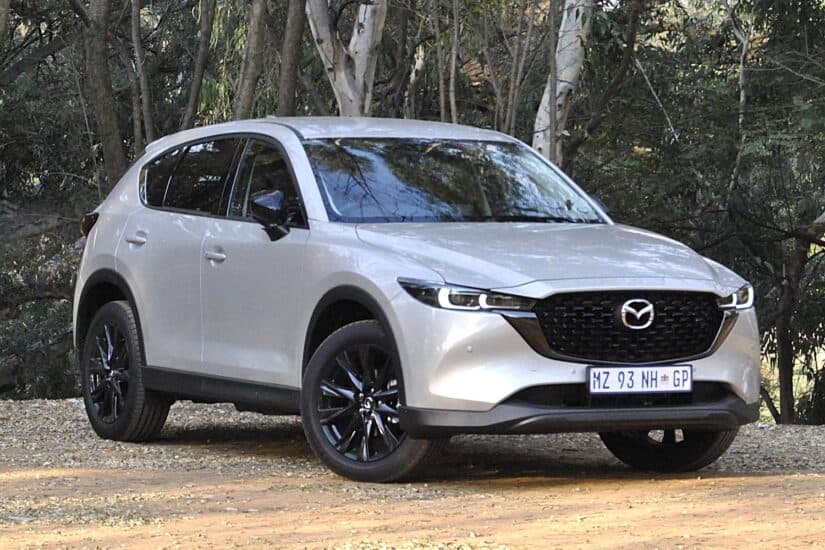
After almost 10 years in production, the internally named KF generation CX-5 has been driven one last time. Picture: Charl Bosch


Although it revealed pricing for what is unquestionably its most important new model at a gala launch last month, this week saw Mazda officially debut the all-new CX-5 as its first completely new model since the CX-60 two years ago.
Success in the eye of gloom
Known internally as the KM, the third generation CX-5 arrives at a pivotal time for the Hiroshima-based brand, whose sales have slumped over the last few years due to rising prices and competition from cheaper and better equipped Chinese products.
The latest legacy brand after Mitsubishi, Subaru and Nissan, whose future has been the subject of ongoing speculation, the arrival of the KM came with the message that pulling the plug on South Africa won’t be happening anytime soon.
Final encore
Prior to the KM’s premiere, though, one last opportunity presented itself to reunite with the now discontinued KF that has been the backbone of Mazda South Africa’s operations despite having been its flagship for more than a decade until the arrival of the CX-60.
Having made its world debut in 2016, the KF CX-5 has soldiered on with relatively few updates, the most recent being the discontinuation of the normally aspirated 2.5-litre SkyActiv-G petrol and the 2.2-litre SkyActiv-D turbodiesel in 2024.
Prior to this, a mid-life refresh in 2022 brought new specification items and subtle exterior changes, but nothing else following the introduction of the Carbon Edition the previous year.
As per the range revision two years ago, the CX-5 was left with a choice of three trim levels, all powered by the normally aspirated 2.0-litre SkyActiv-G engine Mazda opted to drop for the KM in favour of bringing back a revised 2.5.
Arriving in the same Platinum Quartz hue as the CX-30 that proceeded it, the final encore for the KF CX-5 again came in the shape of the Carbon, which had been the flagship variant priced at R688 400.
Aging gracefully
While summarising its last seven-day stint could have been as easy as taking the same right-up from the first test in 2021 and changing a few words, better due justice is required to a generation that has made up the bulk of the 50 000 units Mazda has sold in South Africa since the original went on-sale in 2012.
As part of the refresh, Mazda kept it simple by adding the grille from the CX-50 sold in North America, restyling the front and rear bumpers, fitting a new tailgate and changing the head-and-taillights to an all-LED affair.
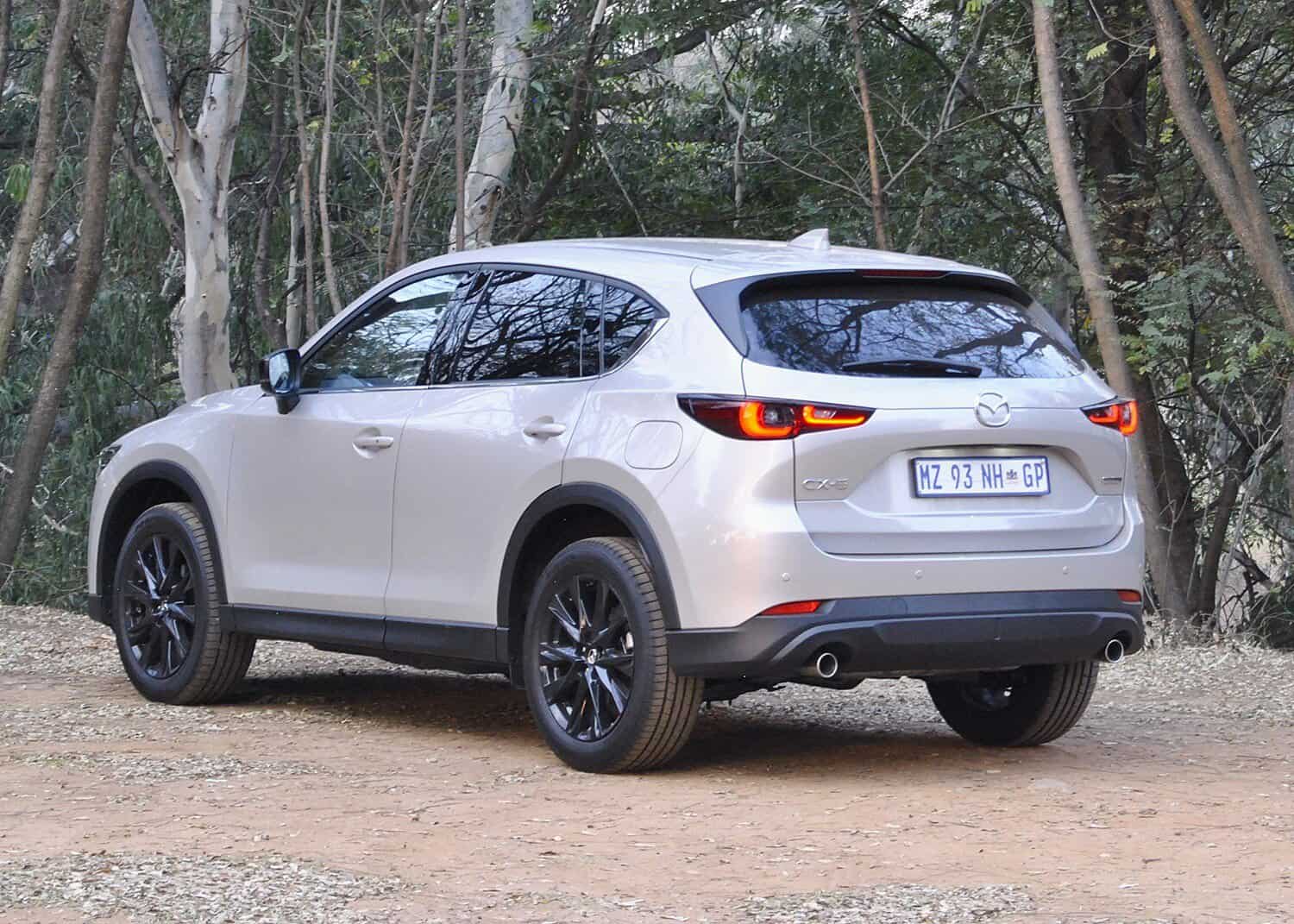
Building on these, the Carbon receives black 19-inch alloy wheels, chrome exhaust outlets, a gloss black faux diffuser and darkened finishes on the grille and mirror caps.
Given the subtlety of the changes, and the CX-5 having been in its twilight years, it has aged remarkably well for a decade-old design that still presents modern, classy and stylish.
While the Platinum Quartz doesn’t resonate as the best of the seven colours Mazda availed, in combination with the Carbon inserts, it contrasts rather well in still making the KF CX-5 a visual standout.
Inside
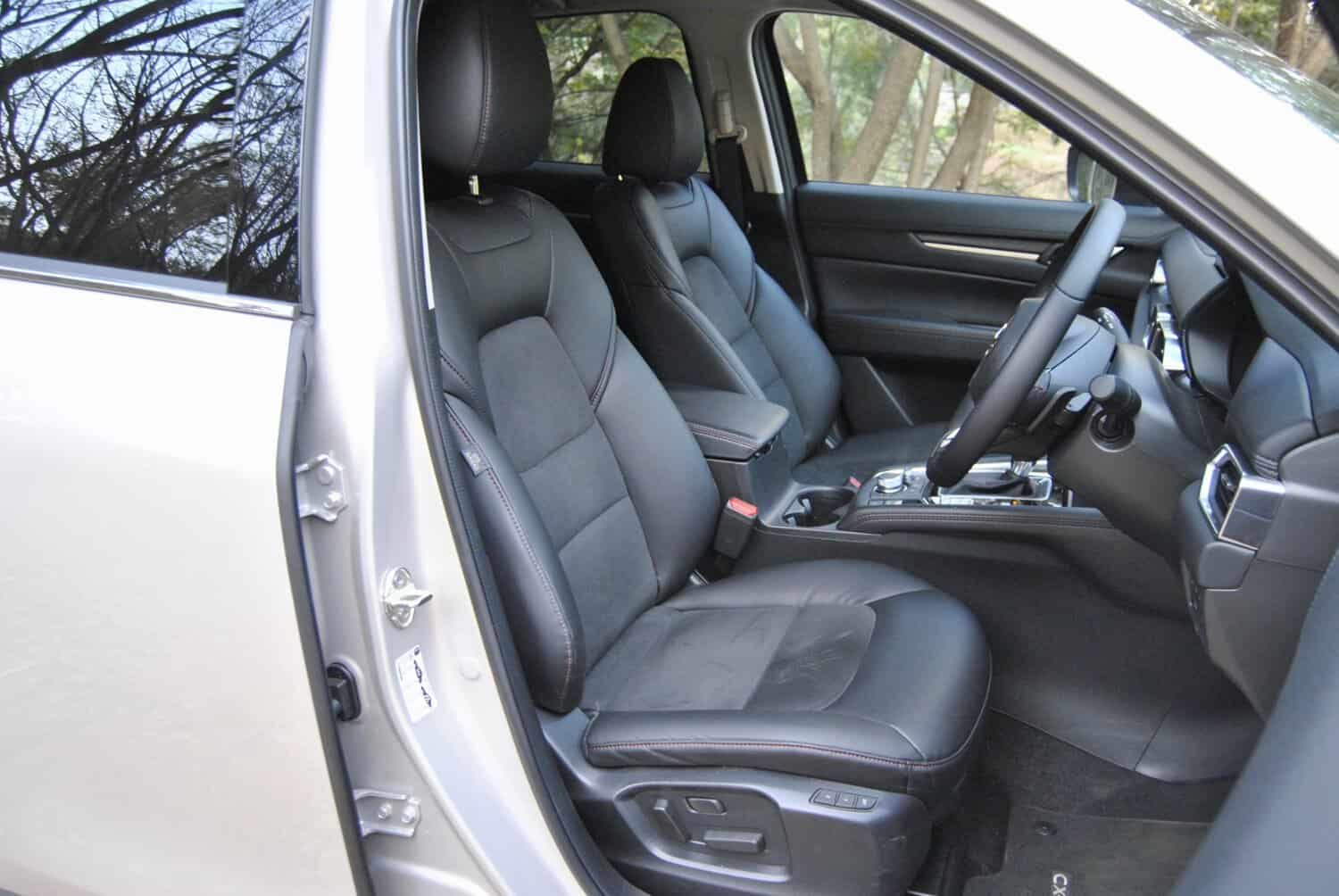
Opening the CX-5’s door reveals an interior that has matured equally as good, given that only new seats were added in 2022 across all variants.
While the Carbon’s unique touches include red stitch work, imitation leather and suede upholstered seats, and black decorative inserts, the overall look still feels premium and arguably, better executed than on the KM.
As much as the black inserts, particularly on the centre console, could have been avoided, built quality is still top notch with not only soft-touch plastics and leathers, but a sense it had been crafted instead of having been simply slapped in place.
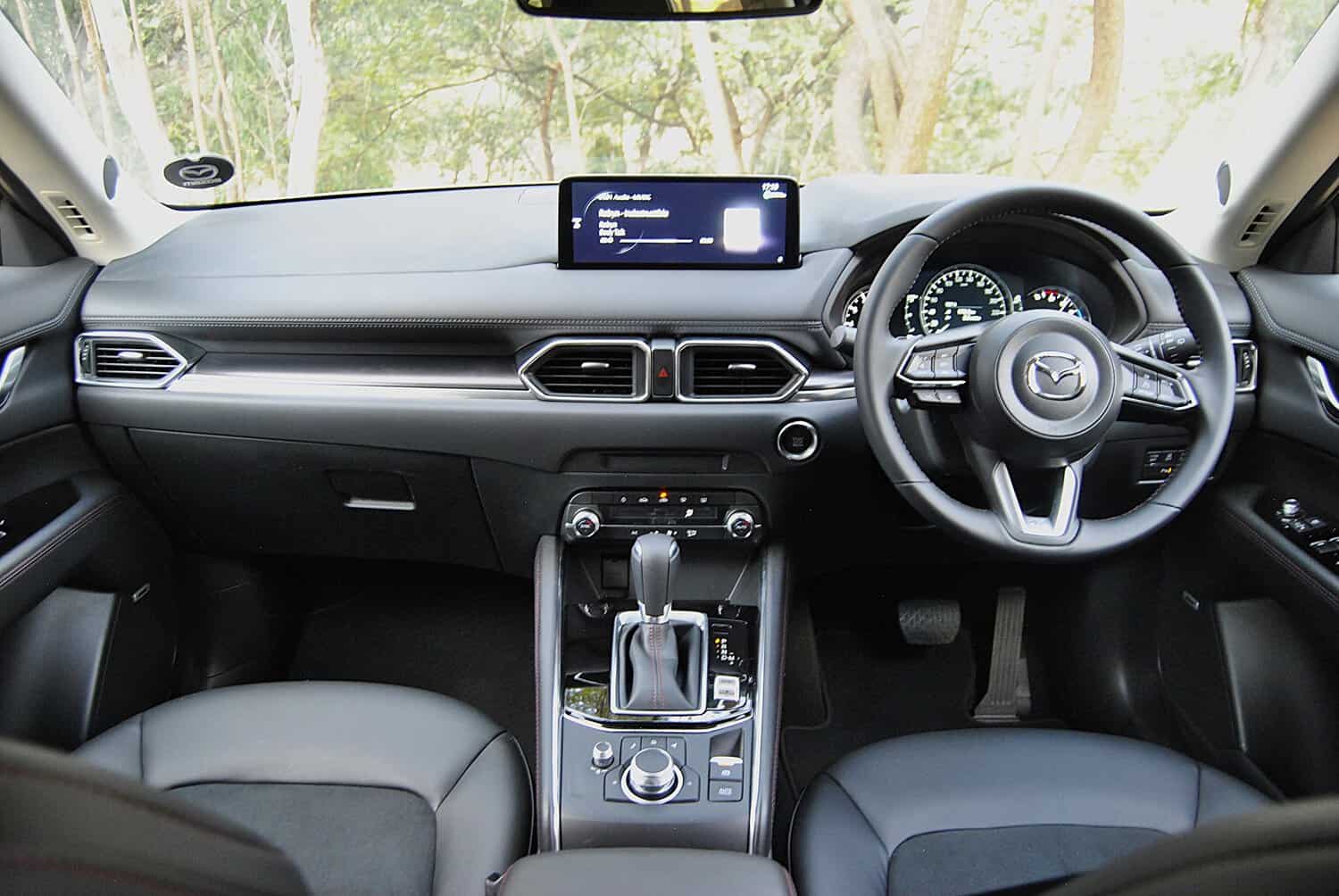
The same applies to the ergonomics as physical buttons dominate from the buttons on the steering wheel to the interface for the dual-zone climate control.
As all of these functions reside within the infotainment system of the KF, buyers looking to trade up will be disappointed considering how good the tactile feel still is.
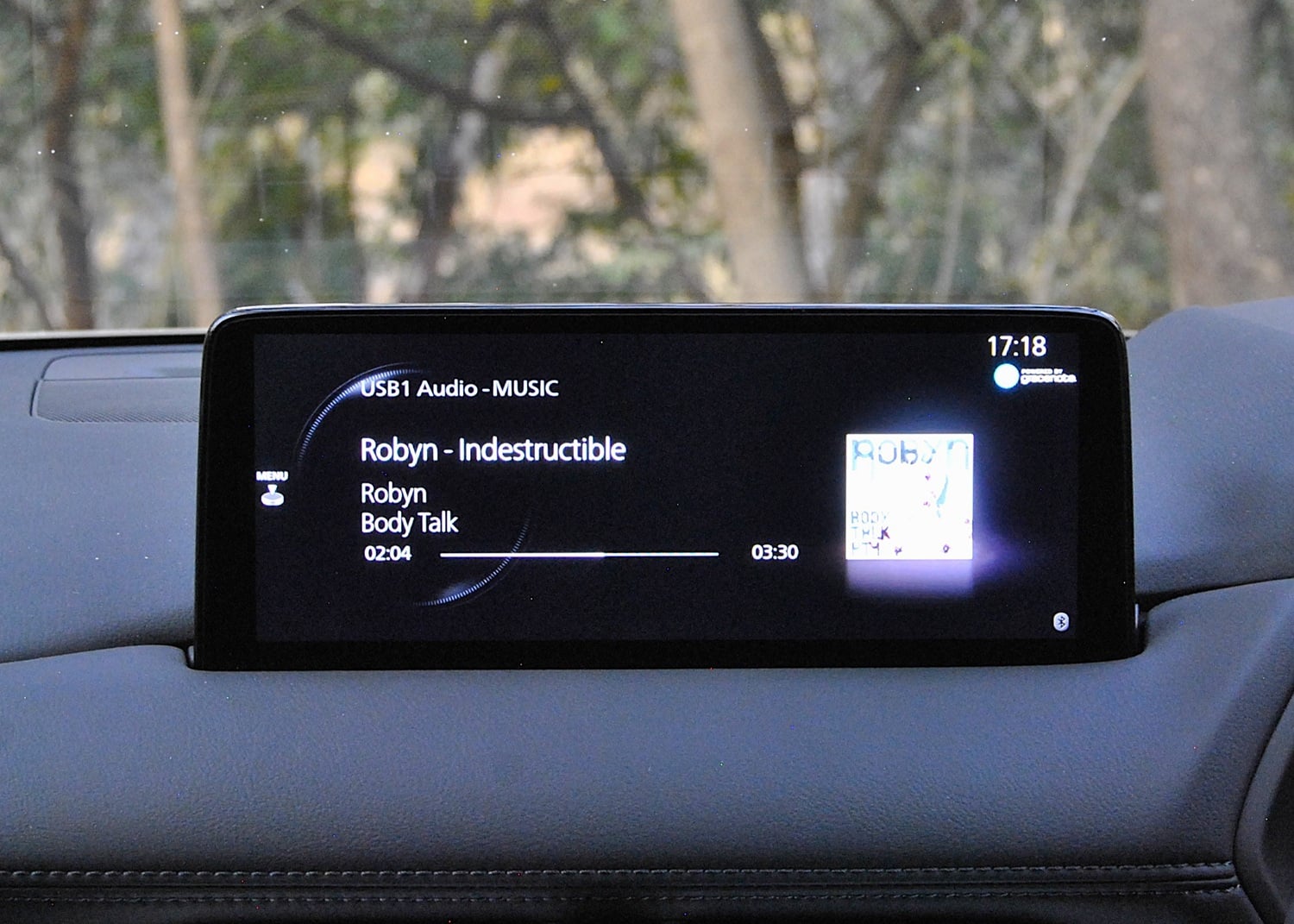
This same applies to the 10.25-inch MZD Connect infotainment system, which has a slick interface aided greatly by the rotary dial surrounded by a series of shortcut buttons and the audio knob on the centre console.
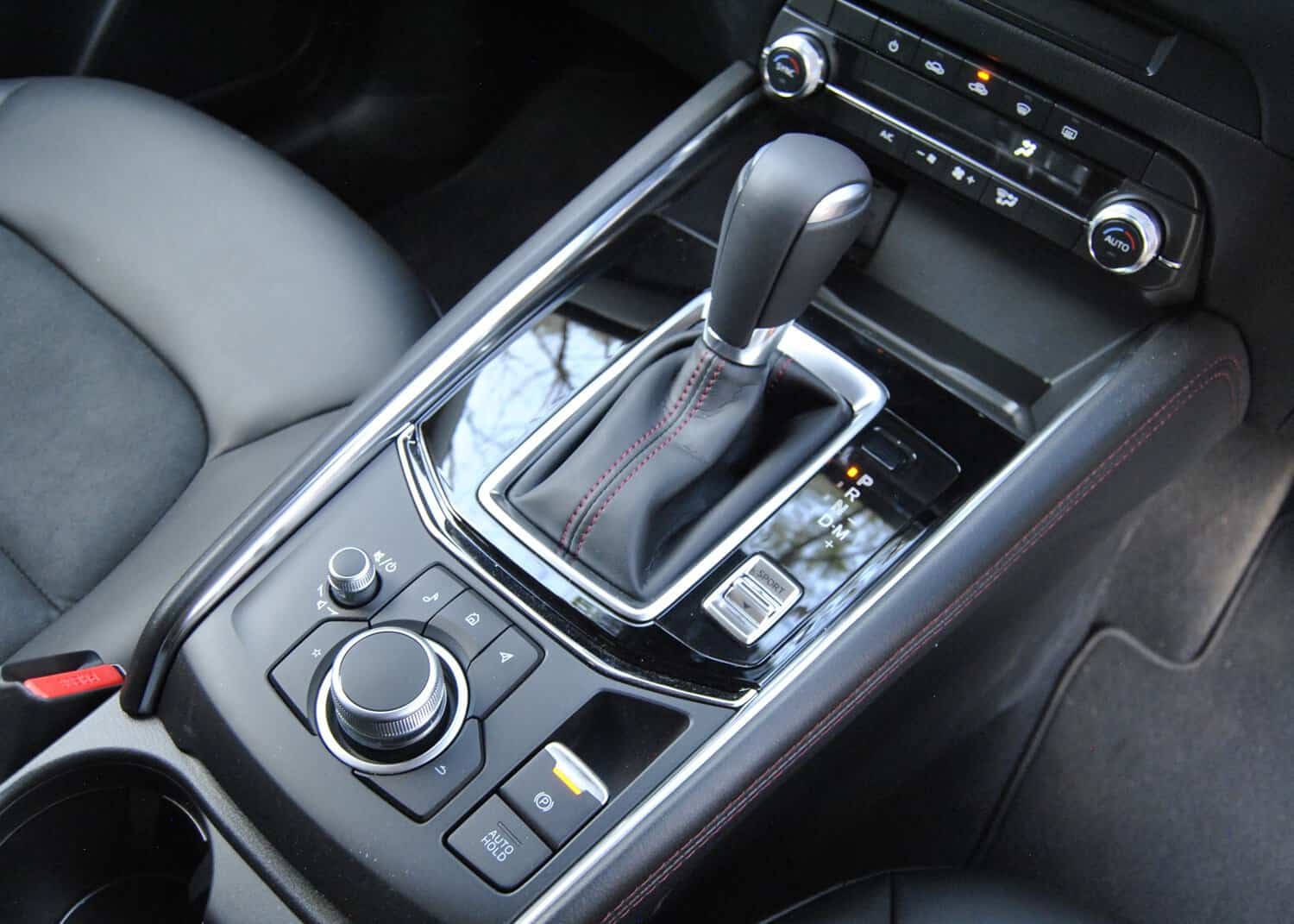
Given that the new 15.5-inch display on the KF omits this in favour of a touchscreen interface, an aspect Mazda has been avoiding until now for safety reasons, the loss of the dial will be missed given how effortlessly it worked and avoided fingerprint blemishes on the screen.
Still fitted with Apple CarPlay and Android Auto, it also sports embedded satellite navigation and serves as the display for the merely decent reverse camera.
Spec
On the specification front, and being the flagship, the Carbon leaves little out as, in addition to a Head-Up Display and a cracking 10-speaker Bose sound system, it has the following as standard:
- rain sense wipers;
- auto folding electric mirrors;
- auto on/off headlights;
- push-button start;
- keyless entry;
- seven-inch TFT instrument cluster display;
- dual-zone climate control;
- electric front seats;
- wireless smartphone charging pad.
Taking care of safety and driver assistance are:
- seven airbags;
- front and rear parking sensors;
- cruise control;
- Automatic Emergency Braking;
- Blind Spot Monitoring;
- Lane Departure Warning;
- Driver Attention Alert;
- Lane Keep Assist;
- Rear Cross Traffic Alert.
Still spacious
Dimensionally shorter and narrower than its successor, the CX-5’s interior is anything but pinched as space at the front and rear fails to disappoint.
In addition, those at the rear receive separate air vents, an armrest with a pair of cupholders and dual USB ports.
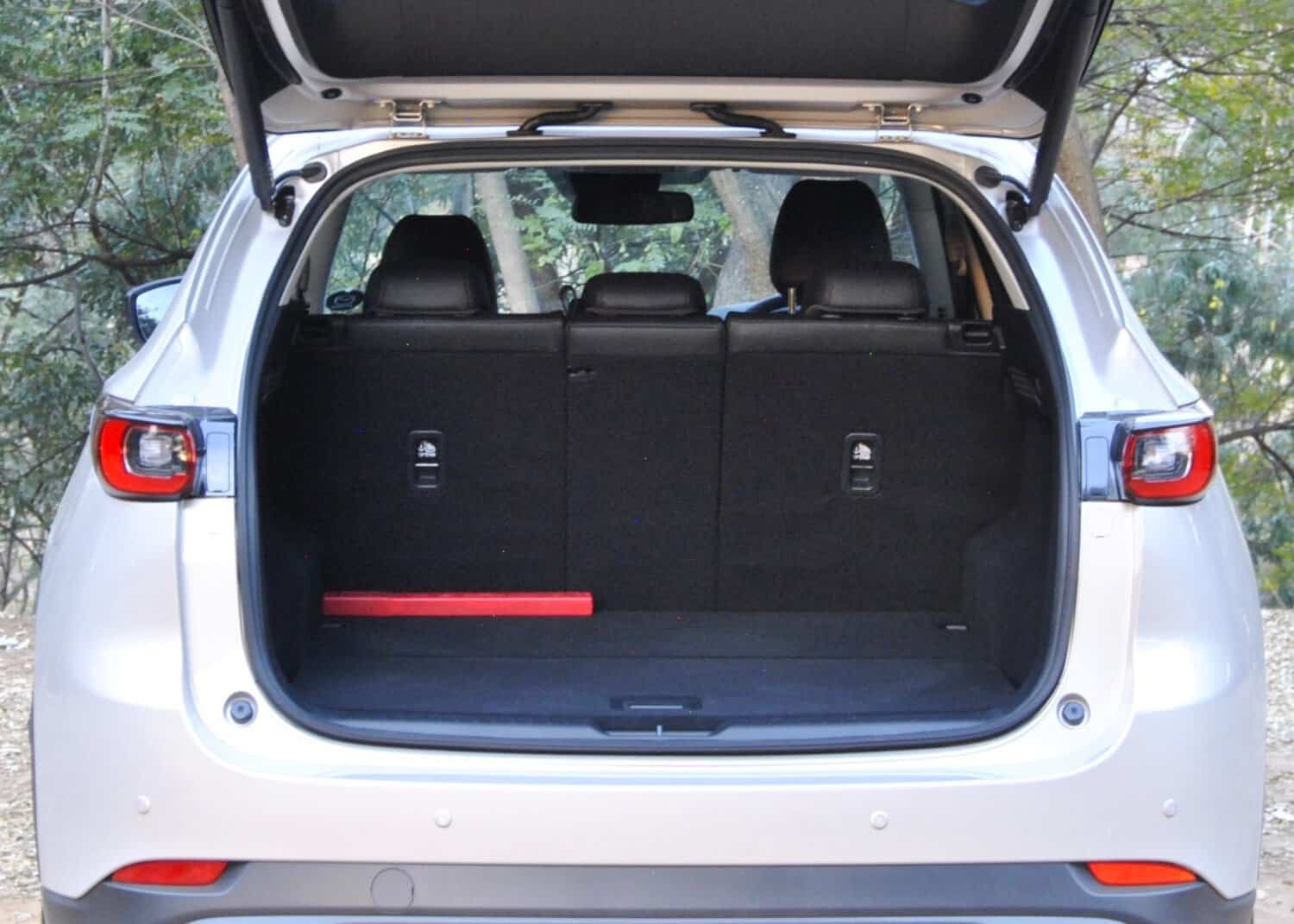
Aside from seat comfort not lacking at the front or rear, opening the electric bootlid reveals a more than adequate 442-litres of space, which increases to 1 914-litres with the 60/40 split rear seat folded.
On the move
It is on the move where matters still go wrong as the retention of the normally aspirated 2.0-litre engine makes the CX-5 feel underpowered, even at its comparatively segment light 1 451kg kerb mass.
The main detraction that persisted ever since the departure of the 2.5 and 2.2-litre, the 2.0-litre’s 121kW/213Nm means it has to be worked hard to keep momentum up, especially low-down the rev range.
A requirement that makes the CX-5 feel heavier than what it is, the knock-on effect is that the six-speed automatic gearbox becomes hesitant and would drop a few gears down to keep the engine on the boil as a result of its meagre torque output.
Slick at lower speeds and able to be manipulated via the paddle shifters or selecting gear sequentially using the lever, the drivetrain remains the KF CX-5’s biggest blunder that the KM is likely to rectify thanks to its greater displacement and 132kW/240Nm.
More accomplished is refinement at speed and comfort, which again belies the CX-5’s age.
Compliant and planed despite drive going to the front wheels only, the suspension irons imperfections out with ease with no unpleasant rebounds, while the steering is sharp and not lacking in feel considering the CX-5 being anything but an MX-5.
Consumption
As with the CX-30, the CX-5 offers a Sport mode. However, the majority of the weeklong stay saw the drive mode selector switched to Comfort mode to avoid the strained engine note and only subtle improvement in throttle response as the revs climb.
Having arrived with less than 300km on its odometer, fuel consumption was expected to be high on the back of the engine having not yet loosened up.
As it turned out, a best of 8.2L/100km was eventually recorded after 280km, a 0.5L/100km improvement on the Carbon’s original tenure five years ago.
Conclusion
Largely blighted only by its powertrain, the outgoing KF generation CX-5 can still be considered as one of Mazda’s biggest triumphs considering what it offers and still represents as a package even though sales have ended.
Elegant, appealing, upmarket and practical, it has been the brand’s biggest star and leaves a solid foundation for the new KM to build on.