Jetour South Africa has fired back after the AA insisted that the company recall their affected T1 and T2 vehicles.
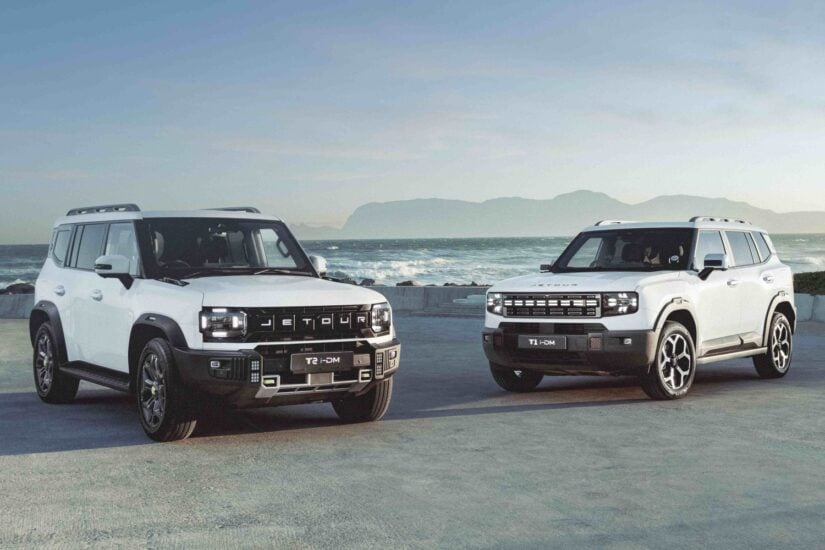
The original payload at the time of the local launch of the T1 and T2 was calculated by Jetour International. Picture: Supllied


It is turning into a somewhat bitter up-and-down battle between the Automobile Association (AA) of South Africa and Jetour South Africa.
Social media sparks war
And it’s all about the original low payload rating of 300kg applied to local Jetour T1 and T2 vehicles by Jetour South Africa.
Social media opinion sparked this war when comments started flying about how this was unsafe for a family SUV expected to carry a full complement of passengers and luggage.
Jetour revises payload capacity
Jetour South Africa responded that it had revised its calculation methods and was now in line with how other local OEMs measure payload capacity.
This resulted in Jetour South Africa setting the new payload rating for the Jetour T1 and T2 at a substantially better 475kg.
AA not buying it
But the AA was having none of this and called for independent testing, especially since Jetour South Africa said no modifications were needed to the T1 and T2 to achieve this new number.
Jetour South Africa duly took part in independent testing with the AA and the National Regulator for Compulsory Specifications (NRCS).
The AA then published figures showing that the T2 Xplora derivative performed 20kg below the updated 475kg payload rating and that no T1 testing had taken place and no approval from the NRCS had been granted for this model range, as stated by Jetour South Africa.
Testing discrepancies
Jetour South Africa then fired back, saying the number they got for the T2 Xplora came in at 479kg, which is 4kg better than the updated figure.
As a result, they can now confirm the Jetour T2 range’s payload capacity is officially set at 475 kg across the range, and that a licensing solution for their T2 customers was being prioritised in consultation with the NRCS, and that further details will be communicated directly to each customer.
No approval for T1
But when we asked the AA for comment on the discrepancy between the numbers on the T2 and whether the T1 had been approved by the NRCS as previously stated by Jetour South Africa, they replied that the T1 had not yet been approved, and that they had no idea where the company came up with a new number for the T2 Xplora.
We found it a little bizarre that Jetour South Africa would fire off a press release claiming a different number for the T2 Xplora and make no mention of the T1, given all the allegations made against them by the AA. So, we asked the company for comment.
We received a response that stated: “The T1 is in the process of being re-weighed. The T2 Explora was re-weighed with the correct like-for-like 10l of fuel and was confirmed to have a payload of 479kg.”
Trouble with the law
But the AA denies any knowledge of re-weighing the Jetour T1 and T2 range of vehicles, and insists that existing Jetour T1 and T2 owners, by law, could still be subjected to the lower 300kg weighting listed on their licence discs at a roadblock or weighbridge.
They could also find themselves in trouble with the authorities and their insurance companies if involved in an accident related to overloading.
Further response expected from Jetour
Jetour South Africa sent us a follow-up email saying a more comprehensive response is to follow, but we have no doubt this saga is far from over.
How the calculations were done
Jetour South Africa has stated that the original payload at the time of the local launch of the T1 and T2 in October 2025 was calculated by Jetour International using the formula:
- GVM (Gross Vehicle Mass) less the MIRO (Mass in Running Order)
Where MIRO is defined as the vehicle’s mass in running condition, typically including standard equipment, operating fluids and fuel and a driver.
Whereas the local formula used to calculate a vehicle’s payload is:
- GVM (Gross Vehicle Mass) less the TARE weight
TARE is defined as the vehicle’s unladen mass, excluding the driver and including standard equipment and a specified amount of 10 litres of fuel, before adding passengers, luggage or cargo.