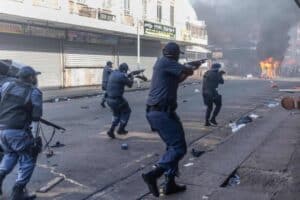
Natjoints says intelligence structures are monitoring in real time as Operation 32 enters full implementation with air wing and units deployed.
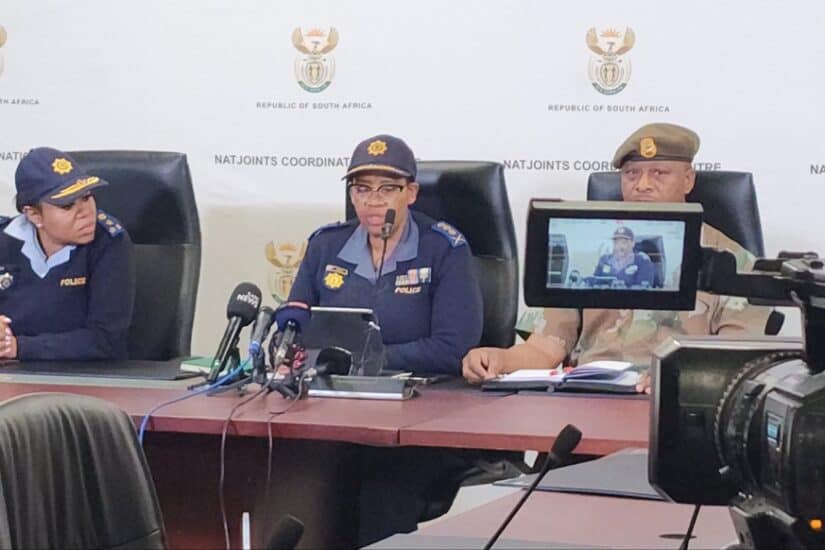
Natjoints media briefing on state of readiness ahead of 30 June marches. Picture: Saps


The National Joint Operational and Intelligence Structure (Natjoints) says that law enforcement is on high alert and intelligence structures are monitoring developments in real time ahead of the 30 June marches.
Less than 24 hours before mass protests against illegal immigration are set to start on Tuesday across the country, the primary operational arm of the Justice, Crime Prevention, and Security (JCPS) cluster briefed the nation on law enforcement readiness ahead of the marches.
Operation 32 enters full implementation
Natjoints co-chairperson and deputy national commissioner for policing Lieutenant General Tebello Mosikili said on Monday evening that the JCPS cluster has entered the full implementation phase of Operation 32.
She added that the national and provincial joint operation and intelligence structures are functioning 24 hours a day, with operators on the ground across all nine provinces.
Mosikili said first responders tasked with public gatherings and incidents, specialised operation units, public order policing units, and the air wing are fully deployed and on high alert.
The co-chair further added that intelligence structures are monitoring developments in real-time, and operational commanders are receiving continuous updates for swift decision-making.
“Our message is simple: do not test the resolve of the state. To those who intend to demonstrate peacefully, we assure you that your constitutional right will be protected,” the lieutenant general said.
According to Natjoints, weeks of meticulous planning, intelligence gathering and operational coordination have led to the current readiness.
Intelligence structures monitoring in real time – Natjoints
Mosikili said contingency plans have been tested and simulated, ensuring no security vacuum.
She added that the coordinator of the marches assured law enforcement of peaceful demonstrations, but there will be immediate consequences for those who cross the line.
The co-chair also emphasised that dangerous weapons are prohibited.
Meanwhile, over the weekend, several arrests were made for public violence and house robbery. This comes after a group of alleged marchers entered the home of a Congolese family in Rosettenville and were harassed.
In terms of cases involving anti-immigrant sentiments, the police have arrested 195 people, and about 103 cases have been registered since 1 March.
The provincial breakdown on reported cases and arrests:
- KwaZulu-Natal: 39 cases and 11 arrests
- Eastern Cape: 12 cases and nine arrests
- Free State: 29 cases and 153 arrests
- Western Cape: 15 cases and 14 arrests
- Gauteng: Four cases and five arrests
- Mpumalanga: Three cases and three arrests
Arrests
“This is an illustration that we are dealing decisively with those who step out of line. Equally, those who are in the country illegally are being arrested,” Mosikili said.
In the last week, the police have arrested more than 2 800 illegal immigrants and more than 50 000 since January.
She also confirmed that the fatality rate for foreign nationals who have died stands at four, with two deaths in KwaZulu-Natal and two in the Western Cape. In the KZN case, one person was arrested, and two people were arrested in the Mossel Bay, Western Cape, case.
Concerning repatriation, Natjoints said more than 25 000 foreign nationals have been repatriated, with strict security measures in place.
For tomorrow, thousands of law enforcement officers from various agencies are deployed across South Africa.
Critical infrastructure, national key points, transport routes, points of entry, healthcare facilities, and shopping centres will receive enhanced security.
Intelligence-led
Law enforcement has also coordinated with municipalities, disaster management centres, emergency medical services, and the private security industry.
“Tomorrow’s operation will be intelligence-led. They will be measured and professional, but they will also be firm and decisive,” Mosikili said.
The co-chair added that those choosing violence, intimidation or other criminal conduct should expect immediate law enforcement intervention and accountability.
“Tomorrow, let us demonstrate to the world that South Africa’s democracy is strong enough to accommodate peaceful protest while firmly rejecting criminality,” she said.