
South Africans head to the polls on Wednesday amid widespread frustrations over service delivery, governance failures.
 Elections 2026
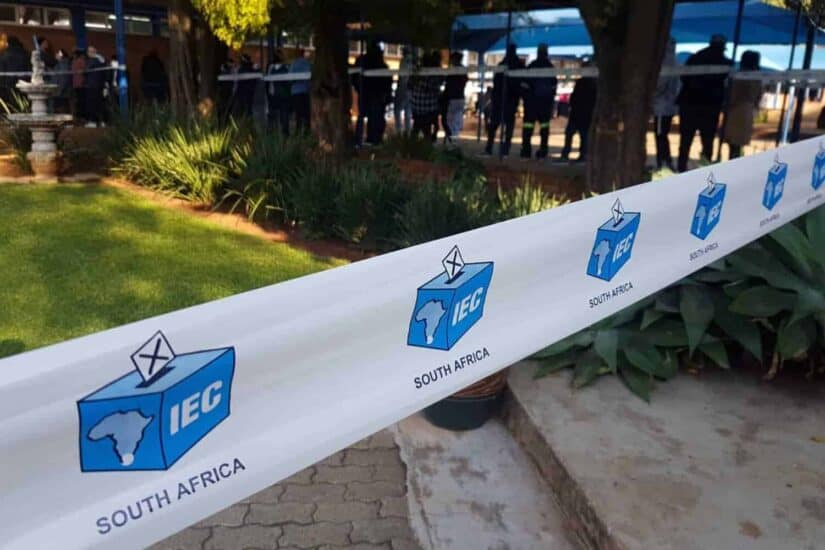
Voters queue during the 2024 national and provincial government elections. Picture: The Citizen


Political analyst Ebrahim Fakir says South Africa’s 2026 local government elections will be “one of the strangest South African elections since 1994”, arguing that the poll is shaping up as an election of “stabilisation, recovery, and rehabilitation” amid what he describes as a crisis of representation and responsiveness.
South Africans head to the polls on Wednesday amid widespread frustrations over service delivery, governance failures, unemployment and crime.
Polling
Recent polling by the Social Research Foundation, MarkData, Ipsos and News24/SABI suggests Johannesburg and Tshwane are likely to return hung councils after the 4 November municipal elections, making coalition negotiations a key factor in determining who governs South Africa’s largest metros.
Get your results on
our Election Hub
Live results
Across the surveys, support for the DA and ANC remains below the 50% threshold required for outright control, while parties including the EFF, MK party, and ActionSA are expected to play influential roles in coalition talks.
Are elections credible?
Against this backdrop, Fakir argues in an opinion piece published by News24 that voters are increasingly questioning whether elections remain a credible instrument of change.
“This will be one of the strangest South African elections since 1994,” Fakir said.
He said the election is unlikely to be driven primarily by ideology, values or policy considerations.
“It is hard to imagine that amid the decline and decay, anyone will vote on the basis of values, ideology, policy compatibility or political fit. That is, if people bother to vote at all.”
Instead, he believes the election will be centred on stability and recovery.
Democratic engagement
Fakir said democratic engagement has increasingly been reduced to voting every five years, while corruption and governance failures persist.
“Democratic engagement through political rights and civil liberties appear to have been reduced to voting every five years while re-enforcing neo-liberal austerity and overlooking elite corruption.”
He said this has led to voters questioning whether elections can still bring about meaningful change.
“In this context, the question facing South Africans is fundamentally existential and tactical. Do they participate in these elections?” he said.
Despite what the polls said, President Cyril Ramaphosa was bullish ahead of the elections. While recognising that the local government elections would be heavily influenced by service delivery, the president told voters that no other political party has done more for South Africans than the ANC.
“There is no other political party. However much they can decorate themselves about having done that and that. On balance, the ANC has done much, much more for our people than what we may have fallen short on. And it is this reflection that I say our people must have,” Ramaphosa said at an ANC rally at the Sisa Dukashe Stadium in Mdantsane, Eastern Cape.
Ramaphosa said the provision of basic services will be a major factor in the local elections.
“This is an important election. It is an election about whether the tap works, whether the street light comes on, and whether the refuse is collected.”
The DA’s deputy head of campaigns Werner Horn said voter turnout could ultimately determine how parties perform.
Horn said most voters had already decided which party they would support. However, he believes undecided voters could still influence the outcome.
Horn said local elections had experienced declining voter participation over recent election cycles. He believes turnout could ultimately determine how parties perform.
He said the DA hopes to secure an outright majority in many municipalities, but warned that low voter turnout could jeopardise that ambition. He added that higher voter turnout could be necessary for the party to secure enough support to establish a stable coalition.
Proportional representation
Fakir further argued that South Africa’s proportional representation system weakens accountability because voters cannot directly reward or punish individual representatives for their performance.
“A party-based PR system severs this chain,” he said, adding that government policy frameworks have failed to identify the electoral and governance system itself as a structural contributor to South Africa’s developmental challenges.
EDITOR’S NOTE: This article was updated on 10 November 2026 to reflect that Ebrahim Fakir’s comments were taken from a column published on News24. A link to the column was added, as well as a link to the News24/SABI poll referred to in the article.