Aside from a reworked specification sheet, the X-Trail's price tag has dropped further from the decrease implemented last year.
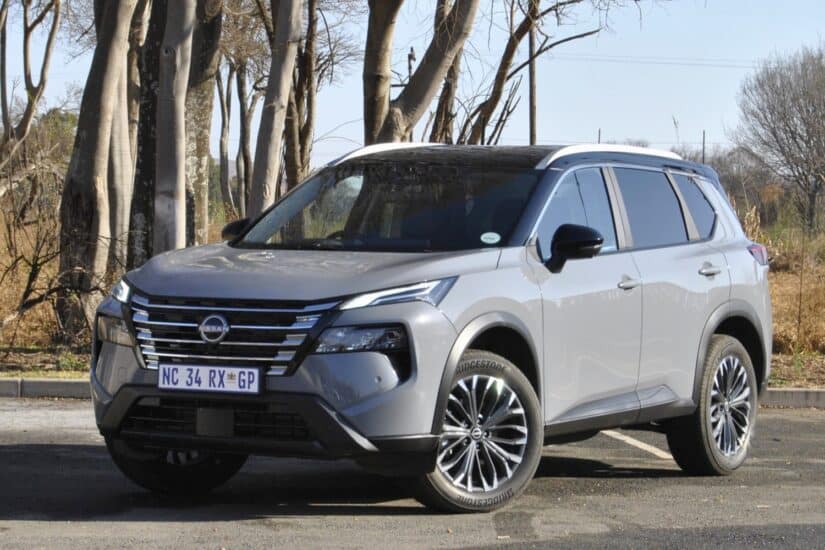
X-Trail has finally been revised with the visual updates applied last year on both the Japanese and Australian variants. Picture: Charl Bosch


Since its unveiling 25 years ago, the Nissan X-Trail has changed considerably from the compact original able to seat five to an almost mid-sized offering capable of seating five or seven.
Back to past form?
One of Nissan’s most recent success stories, with global sales of 8.1 million units, the X-Trail has also been a hit in South Africa since the original T30 arrived in 2002.
Despite an offset of 50 000 units since going on sale, the X-Trail’s popularity has tapered off since the delayed arrival of the current third generation or T33 in 2023.
More premium and upmarket, but pricier and without a diesel engine, the T33 has struggled to make the same inroads, not helped by the influx of cheaper and better equipped models from China.
First ‘refresh’
Nissan’s almost “quick fix” was to lightly update the X-Trail last year with subtle specification upgrades, as well as a considerable albeit limited price reduction of between R63 000 and R100 000, depending on the trim level.
The refresh, though, didn’t involve the more prominent aesthetic tweaks applied to the Japanese and Australian versions last year, nor did it bring the e-Power hybrid system, long known to be under consideration for South Africa.
Now proper
While the price cut has remained, the confirmation of the “fully facelift” X-Trail earlier this month saw it being launched this week, still without e-Power, but at a further limited price reduction.
Centring around the Cradle of Humankind outside Johannesburg, the facelift X-Trail’s arrival forms part of an expanded SUV roll-out which started with the revised Magnite at the end of 2024.
Product expansion
Following the X-Trail, the newly launched Tekton will make its market arrival in September, while the Y63 Patrol will premiere in early 2027.
Still being tested, the new year will also see the arrival of what its still known as the “three-row SUV” based on alliance partner Renault’s Boreal.
A decision that will see the latter filter in above the X-Trail instead of replacing it, the updated model also serves as a final farewell for the T33 after the unveiling of the all-new incrementally detailed T34 in April this year.
New outside
On the aesthetic front, the three models of the X-Trail range all receive a new wider-angle V-shaped mesh pattern grille, a restyled bumper and headlights, new daytime running LEDs and updated side vents.
At the rear, the bumper has been updated and the taillights altered, while the X-Trail name script across the tailgate gains a grey instead of the previous chrome finish.
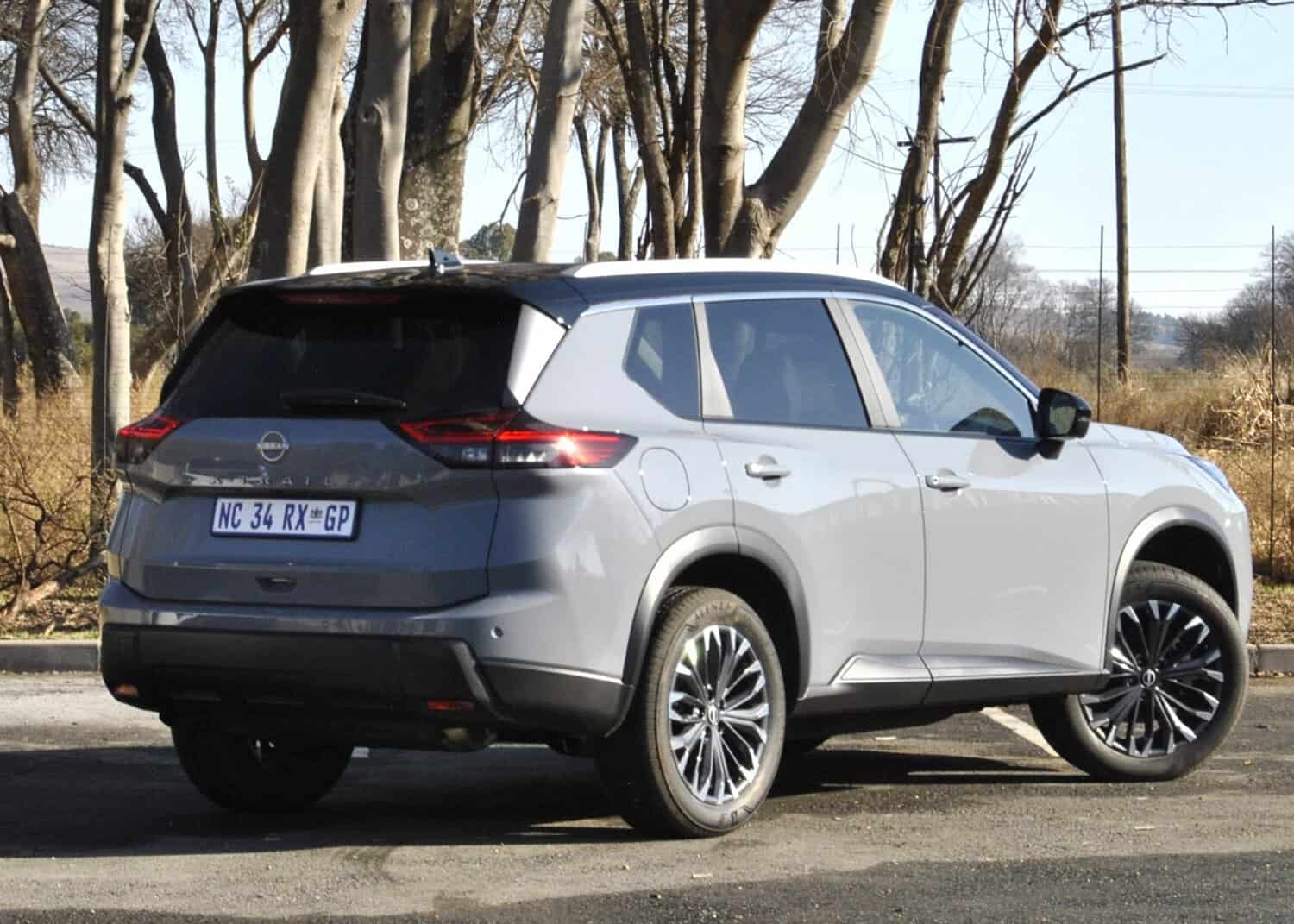
As before, the Visia, Acenta and Acenta+ trim grades are carried over, but with newly designed alloy wheels of 17 inches for the former, 18 inches for the middle grade and 19 inches for the flagship.
At the same time, only the Acenta and Acenta+ can be had with the two-tone exterior finish, highlighted by two new colours – blue and beige – which can still be had in mono-tone form on the Visia.
In addition, the Acenta+ is again only the variant to have not only seven-seats, but also four-wheel drive – the Visia and Acenta being five-seaters with front-wheel drive.
New inside
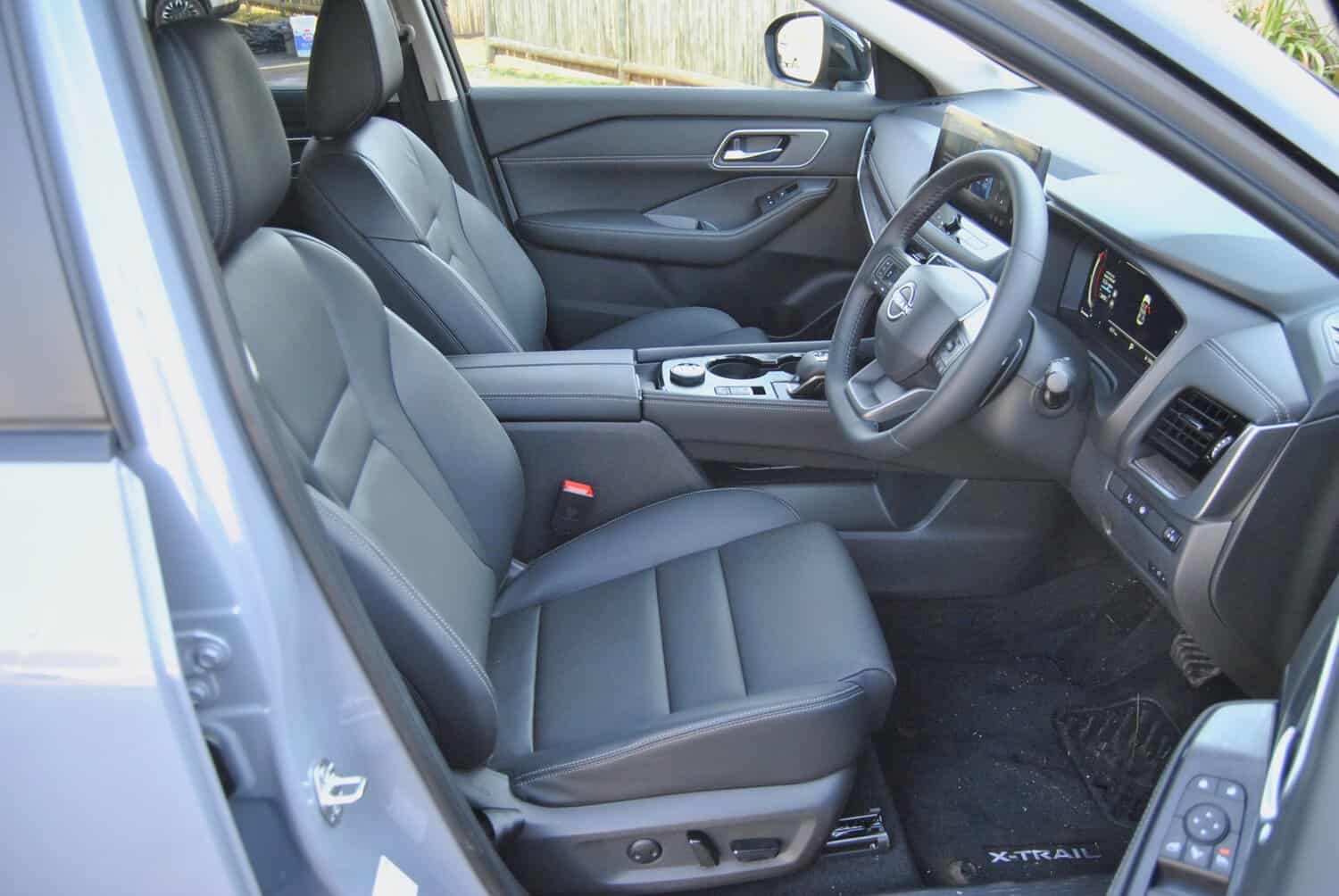
Building on the revisions from 2025, which only included the addition of a wireless smartphone charging pad on all models, as well as walkway lock and approach unlock doors, Nissan has been more thorough by affording each its own upholstery option.
For the Visia, this means a new cloth finish, with the imitation leather on the Acenta and Acenta+ being model-specific in look.
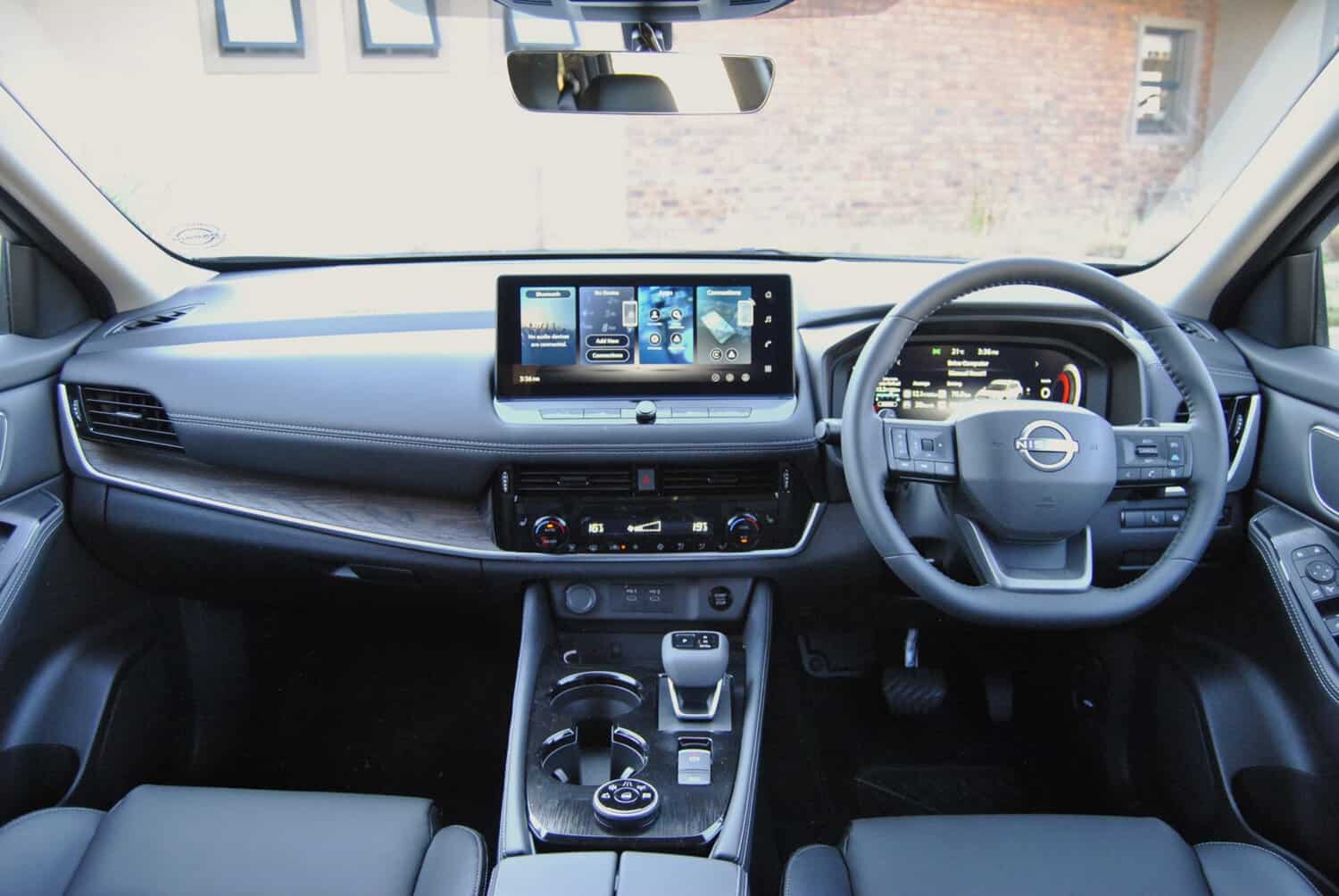
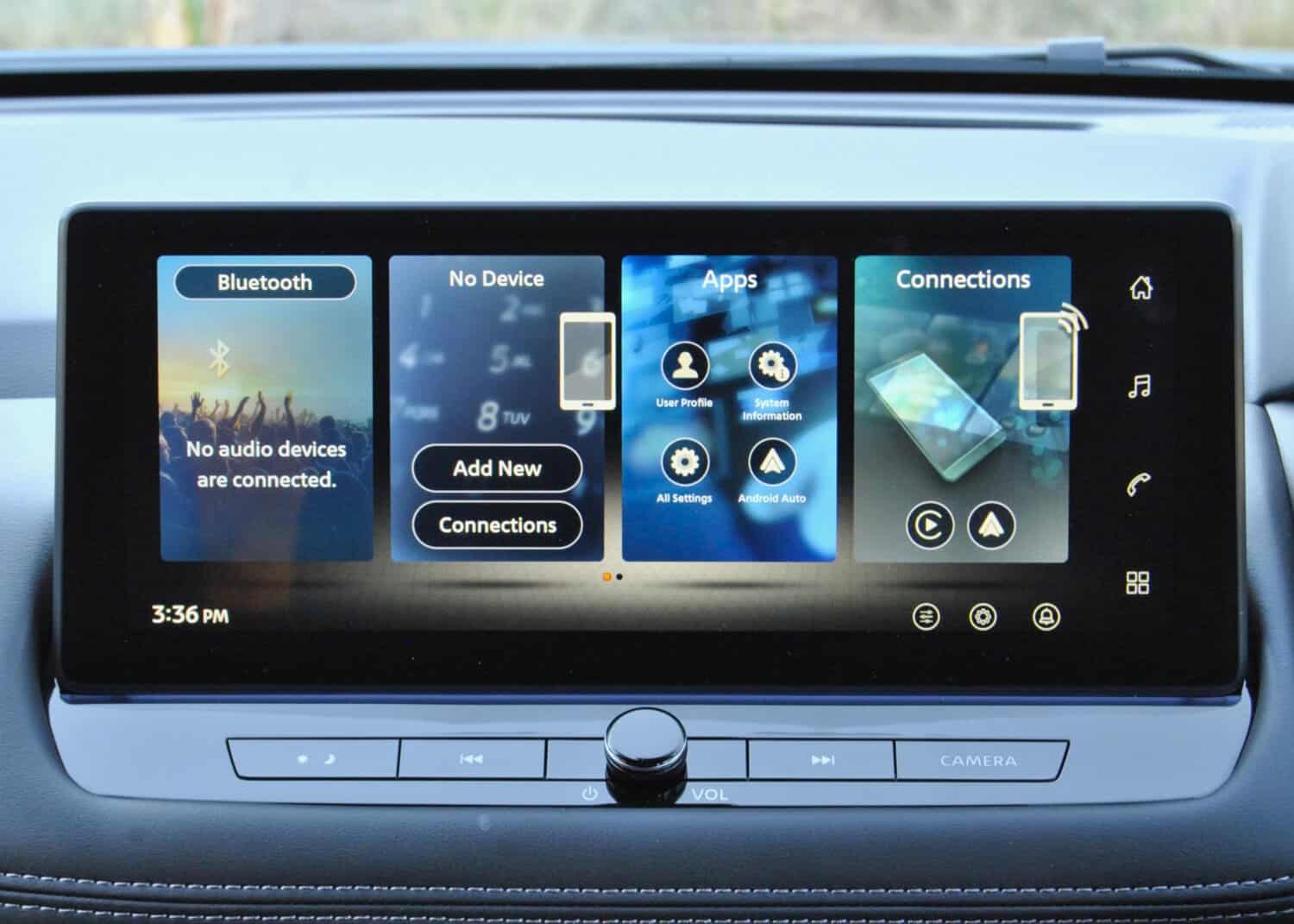
More prominent is the new steering wheel and the 12.3-inch infotainment system with dramatically improved resolution for the surround-view camera system, which all models are equipped with from the start.
Furnished with Nissan’s latest software, plus wireless Apple CarPlay and Android Auto, the setup represents a significant step-up from before.
Not stopping there, the 12.3-inch digital instrument cluster, which had been restricted to the Acenta+, becomes available on the Acenta for the first time, though the former remains the only variant to have a Head-Up Display.
Additional first-time inclusions on the Acenta are the following carried over from the Acenta+:
- dual-zone climate control;
- front parking sensors;
- heated and electric front seats;
- ProPILOT autonomous driving system.
Paddle shifters, the previously mentioned locking doors, wireless smartphone charging pad and rear parking sensors are still standard across all modes, as is a drive model selector with three settings: Eco, Normal and Sport.
On the Acenta+, a new Terrain Mode system has been added with three additional “off-road” settings: Sand, Snow and Mud.
Safety has also been stepped up, with all grades having the following as standard:
- Adaptive Cruise Control;
- Forward Collision Braking
- Blind Spot Warning;
- Hill Start Assist;
- Lane Departure Warning;
- Rear Cross Traffic Alert;
- Lane Departure Prevention;
- Trailer Stability Control.
A tyre pressure monitor features on the Acenta and Acenta+, but only the latter gets Hill Descent Control, a new transparent bonnet view camera and what Nissan calls a T-Junction View display as part of its revised specification sheet.
No change up front
Where the X-Trail hasn’t been changed is on the power front. As before, it keeps the combination of the normally aspirated 2.5-litre petrol engine paired to a CVT.
Producing 135kW/244Nm, the setup will get the X-Trail from 0-100km/h in 10.4 seconds and return a claimed 7.4L/100km. The claimed ground clearance is still 210mm.
Nissan has meanwhile confirmed that while the aforementioned e-Power is “ready” for South Africa, it remains hobbled by pricing constraints brought on by a lack of largely government support for new energy vehicles.
The drive
Out on the comparatively short launch route, the X-Trail failed to disappoint in the same manner as the “pre-updated” Acenta+ driven last year.
Despite its mass, drivetrain and altitude threatening to spoil proceedings, the engine feels smooth and with just enough pull not for it to feel underpowered.
What’s more, the amount of torque is equally sufficient for the CVT not to excessively drone when pushing on.
As only the Acenta+ could be sampled, the inclusion of the four-wheel drive system makes the X-Trail feel surefooted, while the ride is pliant, comfortable and the suspension well tuned when presented with sudden surface changes or imperfections.
What’s more, the steering feels little quick for a vehicle of this type, with refinement inside being also more than commendable against both road and engine noise intrusion.
Conclusion
Following the acquisition of its Rosslyn plant outside Pretoria by Chery, the introduction of the facelifted X-Trail represents the next step in what Nissan calls its turnaround strategy for South Africa.
The first in a series of new models it will roll out, excluding the ones already mentioned, the X-Trail, still faces a tricky route back to the heights of its predecessor against stronger and ultimately cheaper rivals from China.
Its vested reputation and reduced price tag, though, could still swing momentum back into it favour for what is now a much better equipped and still solid segment entrant worth a second look.
Price
All models are covered by a six-year/150 000km warranty and a six-year/90 000km service plan.
- X-Trail 2.5 Visia CVT – R599 900
- X-Trail 2.5 Acenta CVT – R688 900
- X-Trail 2.5 Acenta+ 4WD CVT – R770 900